Showing posts with label books. Show all posts

Monday, April 23, 2018

8 Steps to Effectively Share a Message Step 5: Create a Digital/Print Book

As a leader, Jesus set an example for His disciples, modeling the behavior He want them to copy. As a mentor, He encouraged them to test the skills He taught them, then worked with them to strengthen those skills & make them even better.
You don’t have to be a Christian to appreciate the leadership & mentoring skills of Jesus. Business books have been written, sharing insights into His abilities & offering ways to incorporating those skills into the business world.
While leadership training & development have been hot topics in recent years, mentoring has been largely ignored. This is a major mistake. A leader can’t be fully developed simply through leadership training. Practical experience must be coupled with training. In order for that experience to be most effective, a mentor needs to walk beside the developing leader, offering advice & encouragement along the way.
Unfortunately, a new leader is usually given the training & then sent out to perform, learning over a long period of time by trial & error. For many new leaders, the only mentoring they receive is in the form of discipline when they make the inevitable mistakes.
This situation is even worse for the volunteer leader in the church or organization. In business, there is at least SOME training & guidance. Volunteers are simply given the materials that have been passed down from one leader to the next, patted on the back & told halfheartedly, “If you need anything, call me!” They never call. They never know what to ask or how to begin or how this could happen to them.
For this reason, many churches have a hard time recruiting leaders & an even harder time keeping them.In this series, I’m sharing 5 simple steps to use when mentoring new leaders. They don’t take much time, they just take follow-up & consistency. I developed these steps by studying the method Jesus used to prepare the disciples for leadership. Not all the men He chose as His disciples were born leaders. Jesus trained them & mentored them during their time together, creating leaders that went on to begin & build a thriving organization.
Have you been mentored or mentored someone else? How was the experience for you? Do you have questions about mentoring? Share them with us in the comments.Training & mentoring leaders is the way to empower your organization & ensure the continuation of your programs. It is worth all the time & effort you put into the process considering all the benefits you reap!
" data-blogger-escaped-data-image-meta="[]" data-blogger-escaped-data-image-title="5 Proven Steps to Mentor New Leaders: Introduction" data-blogger-escaped-data-large-file="" data-blogger-escaped-data-medium-file="" data-blogger-escaped-data-orig-file="" data-blogger-escaped-data-orig-size="" data-blogger-escaped-data-permalink="https://simplyjeanann.wordpress.com/2018/03/29/5-proven-steps-to-mentor-new-leaders-introduction/" src="https://iamempowered117.files.wordpress.com/2017/03/create-a-digital-print-book.png?w=300" style="">

You created a booklet & began offering it on your website & on your product table during presentations. The response has been great. People are reading the material & asking questions, making comments. You have been doing research, open to more information on the topic. You add to your notebook containing material on this message. After careful consideration, you decide it’s time to create a full book.

Friday, April 20, 2018

8 Steps to More Effectively Share a Message Step 4: Create a Booklet

You might believe this is an unnecessary step. You would be mistaken. A booklet serves many purposes in this process. Let’s see what some of them are:

Allows You to Expand Your Message

Your blog series should contain plenty of useful information. You never, however, want to put everything about a topic into any one piece of the process until you get to your book. And even then, you want to be able to refer readers to other formats, like a video or podcast, for even more information. Anyway, while your blog series is more detailed than the infographic, you should have more information to share. I find once I write my blog posts, I begin finding other information to support my message. Or people write comments that offer information or ask questions that help me see areas I need to further develop. A booklet allows you to do this.

Quick to Put Together

You might scoff at creating a booklet, preferring instead to wait until you complete a book. A full length book may take 6-12 months to complete. A booklet can be finished in a weekend. This doesn’t mean you simply throw it together. You always want to create a quality product. Some items, however, can be created in a shorter amount of time than others.

Easy to Giveaway

I always produce a digital version before I have a print version made. A digital version can contain hot links to your blog, your podcast, videos, social media & third party supporting information, like a book that adds on to your message. A digital booklet makes an excellent giveaway for people that subscribe to your mailing list. I just add the PDF to my website & make that the landing page.

A Quick New Item for Your Product Table

If you are really hot on your topic, you want to share it with people as quickly & easily as possible. A booklet allows you to have a physical product to sell when you do events. Your booklets may contain all the information some people want. They are also an inexpensive way for members of your audience to take a piece of you home with them at a low cost. When you do a bang-up job during a presentation, people like having a memento for lack of a better word, to take home with them. While books can be expensive, a booklet is usually only a few dollars. You may find your booklets are the best selling item on your product table.

It Is More Forgiving

There is nothing worse than spending months-years writing a book, having it printed only to discover all the changes you want to make. It’s always hard to let go of your book once you are done writing it. You always want to do MORE! I’m talking about major changes. Info you could have added. Mistakes. A booklet allows you to see where there are holes & gives you the opportunity to fix them. And at a much lower cost then a book. I only print a few booklets at a time so I can make revisions as necessary.

Now you can see how important a booklet is in this process. It is well worth the time & minor expense to produce a booklet, ensuring your future book is filled with even more valuable information than you thought possible.

Wednesday, June 21, 2017

8 Steps to Effectively Share a Message Step 5: Create a Digital/Print Book


You created a booklet & began offering it on your website & on your product table during presentations. The response has been great. People are reading the material & asking questions, making comments. You have been doing research, open to more information on the topic. You add to your notebook containing material on this message. After careful consideration, you decide it's time to create a full book.

Start Digitally

There is no better feeling for an author than holding a print copy of their book in their hands. It's also great walking into a bookstore & find their book on the shelf. As desirable as these two experiences are, I want to strongly recommend you not rush into having a print book, whether you self-publish or sign a contract with a publishing house. The first thing you want to do is go digital. A digital book enables you to write a full-sized book without the expense of printing. Printing is very expensive. Also, printing is final, more or less. Digital books offer you flexibility.

Digital Flexibility

No matter how many times you go over your manuscript, you ALWAYS find things you want to change after your book has been printed. New information becomes available. You think of things you want to add. You don't like the way you worded certain things. You might be able to eventually make changes in your book should it ever be considered for a revised edition. Or you just might have to live with those desired changes. Or, you release your book in a digital format first, giving you the opportunity to make any changes you want to make before the manuscript goes into print. You are even able to take a different approach to the material at this point. A message that worked well all the way up to a booklet may begin to break down once you expand it into a book. The digital book causes flaws to rise to the surface BEFORE you commit the material to print. A digital book can be your best friend, your most powerful tool in this entire process. It can save you the heartburn of struggling with a print book

Now You Can Print

Once you have the manuscript as close to perfect as you can get it (you will never be COMPLETELY satisfied), you are ready to create print copies. Now, I have strong opinions about whether authors should find a publisher or self-publish. I am not, however, going make my case one way or the other in this post. If you decide to go with a publisher, you should begin the process early on. You might find a publisher when you first develop the idea. Or you might need to show the popularity of your message by offering sales #'s to potential publishers. If you decide to self-publisher, there are so many more options than when I had my first book published. In addition, self-published books get more respect today than they did even 10 years ago. You really need to do your homework to determine which option is better for you & your book. Which ever option you choose, remember, the success of your book always rests in your hands!

Tuesday, June 20, 2017

8 Steps to More Effectively Share a Message Step 4: Create a Booklet


You might believe this is an unnecessary step. You would be mistaken. A booklet serves many purposes in this process. Let's see what some of them are:

Allows You to Expand Your Message

Your blog series should contain plenty of useful information. You never, however, want to put everything about a topic into any one piece of the process until you get to your book. And even then, you want to be able to refer readers to other formats, like a video or podcast, for even more information. Anyway, while your blog series is more detailed than the infographic, you should have more information to share. I find once I write my blog posts, I begin finding other information to support my message. Or people write comments that offer information or ask questions that help me see areas I need to further develop. A booklet allows you to do this.

Quick to Put Together

You might scoff at creating a booklet, preferring instead to wait until you complete a book. A full length book may take 6-12 months to complete. A booklet can be finished in a weekend. This doesn't mean you simply throw it together. You always want to create a quality product. Some items, however, can be created in a shorter amount of time than others.

Easy to Giveaway

I always produce a digital version before I have a print version made. A digital version can contain hot links to your blog, your podcast, videos, social media & third party supporting information, like a book that adds on to your message. A digital booklet makes an excellent giveaway for people that subscribe to your mailing list. I just add the PDF to my website & make that the landing page.

A Quick New Item for Your Product Table

If you are really hot on your topic, you want to share it with people as quickly & easily as possible. A booklet allows you to have a physical product to sell when you do events. Your booklets may contain all the information some people want. They are also an inexpensive way for members of your audience to take a piece of you home with them at a low cost. When you do a bang-up job during a presentation, people like having a memento for lack of a better word, to take home with them. While books can be expensive, a booklet is usually only a few dollars. You may find your booklets are the best selling item on your product table.

It Is More Forgiving

There is nothing worse than spending months-years writing a book, having it printed only to discover all the changes you want to make. It's always hard to let go of your book once you are done writing it. You always want to do MORE! I'm talking about major changes. Info you could have added. Mistakes. A booklet allows you to see where there are holes & gives you the opportunity to fix them. And at a much lower cost then a book. I only print a few booklets at a time so I can make revisions as necessary. Now you can see how important a booklet is in this process. It is well worth the time & minor expense to produce a booklet, ensuring your future book is filled with even more valuable information than you thought possible.

Monday, June 19, 2017

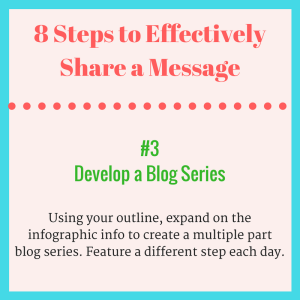
8 Steps to More Effectively Share a Message Step 3: Develop a Blog Series

develop-a-blog-series


Is the Subject Expandable?

Once I create an infographic, I like to create individual blog posts for each step. This enables those that want to get more information on the topic. It also enables ME to determine if I have enough material to write a book. If I can't do a decent blog series, then I'll never be able to come up with enough info to write a book.

A Path to Podcasts & Videos

The blog series also helps you begin the process of creating podcast & video material. I simply take the info from a blog post or series, add to it where necessary & go into production. Depending on the length of each post, I might do either one long program or break it down into smaller pieces just like the blog series. I learned early on to keep audio & video short to give my busy audience the opportunity to listen & watch. I can always put the segments together & make one long program. More on this later!

Design Graphics for Blog & Social Media

At this time, I also create the graphics I need for the blog series. You can see an example at the top of the page. In Canva, I design the first piece & then make copies for each additional post. This is also when I design graphics for social media. I want to share the blog posts in as many places as possible. Designing graphics for Twitter, Facebook & more gives my series a consistent look across the board. Canva offers templates for various platforms so this is easy to do.

Determine the Best Time to Post

I prefer to share the posts from a series M-F. This gives readers time to catch up on the weekend if necessary. I have also found that I have the most readers during the week for this type of post.

Developing a blog series from the steps on an infographic is a great way to expand on a good topic & discover other ways you can use the information across platforms & formats.

Wednesday, June 14, 2017

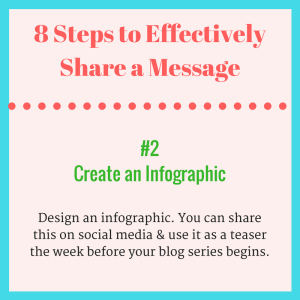
8 Steps to More Effectively Share a Message Step 2: Create an Infographic


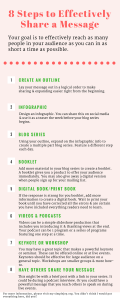
Once you have created your outline, it is simple to design an infographic. This is a, well, graphic that basically has your outline on it. 

Like this:


 I use Canva to design my infographic. They have many free designs from which to choose, including designs for infographics. The great thing about Canva is you can choose a template for the specific use & it is the right size for that format. For example, if you need a new header for your Facebook page, they have a template for that as well as a Twitter header, etc. You don't have to guess what the correct size is for your need.

Design Graphics at One Time

I try to design various graphics at the same time so they all match. Yes, I know how OCD that sounds. Guilty! This, however, enables me to brand each series I create. You notice the infographic & the blog graphic have the same colors & line design. Ta-da! I am also able to design a graphic for Facebook, Twitter, Linkedin, & more. All the same design that has been plugged into a new template.

Creating the Infographic

The infographic is basically my outline. I make sure it has enough information so anyone that only sees this one part of the process is able to apply the lessons offered in the infographic. I ALWAYS make sure each step of this message sharing process not only supports & builds on all the other steps but is able to stand alone & help my audience, even in a limited way. An infographic doesn't offer a whole lot of information but I make certain that small paragraph is powerful. And hopefully causes the reader to want to learn more.

Why Bother?

So why bother with an infographic? First, you can use it as a teaser for your upcoming series. Share it on social media the week before your series begins. I also share it on Pinterest with a teaser before the series begins & then again with a link to my blog once the series has started. I pot it on my blog to let subscribers & potential subscribers know this series is coming. I send it to my mailing list. And on & on.

Rack Cards

You can also have your infographic printed as a rack card that you place on your product table when you have a speaking engagement. Rack cards give your audience a free takeaway that invites them to visit your blog for more information. As you can see, infographics play an important role in the process of effectively sharing your message & are well worth the time to design.

Tuesday, June 13, 2017

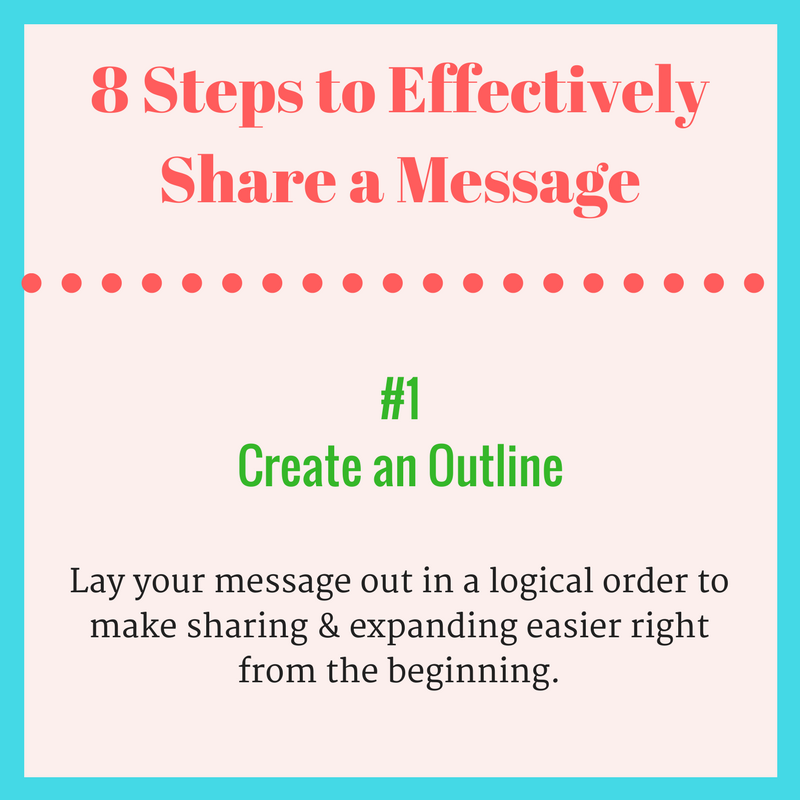
8 Steps to Effectively Share a Message: Step 1 Create an Outline


 I could hear you groan, you know! Outlines seem tedious. Perhaps you never had to learn about outlines in English class. They were a pain! Breaking things down into smaller & smaller pieces with very specific tags to identify their place in the outline. It was painful & confusing.

Not Your English Class Outline 

 This is not that type of outline. When I began as a speaker & author, I studied under Florence Littauer. We were taught that outlines help us formulate the message in a logical order. How many times have you listened to a speaker that motivated & inspired you yet later, you were unable to share anything they said in their presentation? The speech might have been very well written but if it wasn't created in a systematic format, your brain is unable to retain the information.

Is There Enough for a Series?

When I come up with a great topic, like this one, the first thing I do is create an outline. This enables me to see if I am able to develop a message from the idea. If I can't flesh it out into a simple outline, then I know I only have an informational graphic to share on Instagram.

It's Easier than It Sounds

You want an outline that makes it easy for your readers or listeners to remember your material & easy for you to share it across multiple formats. An outline makes it easy for me to first create an infographic & then break it down into a blog series. Your outline is easy to create. Pick a word that represents your message & make an acrostic. For example, TALK: Teach, Act, Listen,Keep. Or you might you words that rhyme: Make, Take, Wake. You can use an analogy. To share my Simple Joy message, I created a message using a tree through the seasons. It takes some effort at first but it becomes very easy, very quickly.

Well Worth the Effort

Take the time to develop an outline & you have the foundation for a message that can go from infographic to book!